← Biblioteca · Revista Cazimi
Belchior, um sujeito da sorte de Marte

Presentemente com os primeiros raios de Sol do dia 26 de Outubro de 1946, na pequena cidade cearense de Sobral, o são e salvo e forte signo de Escorpião ascendia no horizonte, anunciando o horóscopo de um sujeito de nome Antônio Carlos Gomes Belchior Fontenelle Fernandes. O violeiro que sabia latim, ao folhear as gregas etimologias, verificaria que o latinizado ‘horóscopo’ quer dizer, simplesmente, ‘ver a hora’. Na Astrologia, horóscopo é sinonímia de Ascendente, um ponto fixo ao leste do horizonte, de onde nasce o Sol e para quem o galo canta. Horóscopo pode ainda, em razão da importância simbólica desse ponto geográfico, designar um mapa inteiro, como uma vida que passa a ser contada a partir da hora em que é avistada.
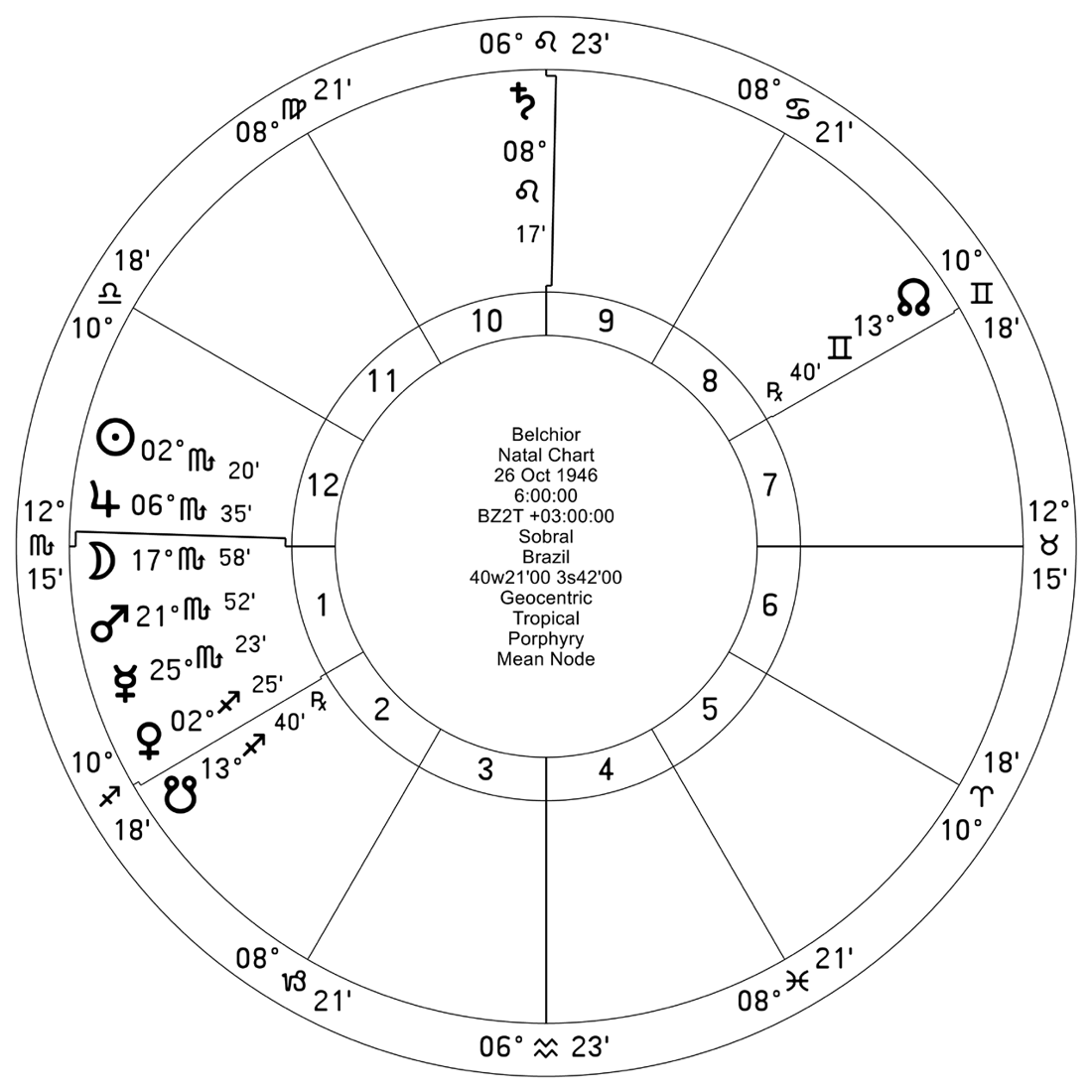
Ascendentemente às 6h da manhã, nascia Antônio Carlos, junto ao signo de Escorpião, que levantava consigo cinco dos sete astros: o Sol, claro, pois era dia, estava em seu 2º grau, e sucessivamente, como fiéis desse enigmático rei, ascendiam Júpiter no 6º grau, Lua no 12º grau, Marte no 21º grau e Mercúrio no 25º grau.
O Ascendente é o lugar que designa o próprio sujeito, sujeitado ao seu corpo físico, onde a vida profundamente palpita. É onde o coração latinamente americano, late – do espanhol, bate – e também apanha. Ascendente é, latindo de novo, o motivus – onde a vida sai da inércia para iniciar o seu movimento. É o começo. E por que Escorpião é um signo da sorte de Marte, seu domicílio noturno, e está, como quase todos os astros, no princípio do mapa, as motivações do violeiro-cantador se apresentam de modo direto e precoce. Marte é um astro de qualidade excessivamente quente e seca, propenso à ação, ao embate, à ousadia. Escorpião, porém, é de qualidade fria e úmida, contrária à de Marte, que atenua a propensão ao conflito direto, conferindo-lhe um certo tom de ameaça, como ouvimos na canção Comentário a Respeito de John, como ali se anunciasse o afiado gesto de seu nascimento.
Saia do meu caminho
Eu prefiro andar sozinho
Deixem que eu decida
A minha vidaNão preciso que me digam
De que lado nasce o Sol
Porque bate lá meu coração1
Com tantos astros batendo onde a vida começa, se pode inferir que muito do que figura o mítico Belchior de quem hoje falamos, se constituiu em seus primeiros anos de vida. Desta constatação, nos inclinaremos para as suas Progressões Secundárias, técnica preditiva que pressupõe uma relação temporal simbólica, na qual cada dia após o nascimento equivale a 1 ano de vida. Tomando como hipótese a relação do Ascendente com os começos, o interesse das análises seguintes toma dois momentos: o primeiro, biográfico, de seus primeiros anos; e o segundo, de sua primeira canção defendida no palco, Na Hora do Almoço (1971).
Pequeno mapa do tempo
Se é de Marte que estamos tratando, medo e coragem se alternam como narradores bivitelinos das lendas do herói. As histórias e anedotas que ilustram o seu Mapa Natal estão contidas na biografia Belchior: Apenas um rapaz latino-americano (2017), escritas por Jotabê Medeiros em tom espirituoso, como que aferroado pelo humor agudo e audaz de Belchior, de quem o biógrafo, sabiamente, desconfia. Dentre as valentes narrativas do “violeiro de Marte”2, inclinado ao brio, ao valor e ao desgarre, estão as de que na infância ele foi cantador de feira e de que a mãe era cantora de coro da igreja. E se é certo que o Ascendente é o próprio sujeito em questão, e que constem ali Sol, Júpiter, Lua, Marte, Mercúrio e a Parte da Fortuna, é natural que ele solicite, como na canção, a decisão sobre a própria vida, recontando a sua história, fértil de versões. Astrologicamente, é como se todos os assuntos, simbolizados por tais astros, estivessem em suas próprias mãos, como as pinças do Escorpião que se fixam no timão do próprio Destino, do qual Marte é o nem-tão-destemido-assim capitão.
Também a Lua, que nessa narrativa teatral representa temas subjetivos, como as memórias e os sentimentos, está sob os seus desígnios. Quando em Escorpião, diz-se que a Lua está em queda, detrimento ou depressão. Igualmente, a Lua representa a mãe. Em um signo de Marte, da perspectiva do mapa deste seu filho, dona Dolores (Dolores!), carregava consigo histórias de batalhas, da perda de filhos natimortos ou ainda miúdos, e também da luta pela criação dos que seguiram, como se a própria Lua bordasse em uma bandeira da campanha de Marte o seu código de honra: a vida que vinga, revida.
Que o pecado nativo
É simplesmente estar vivo
É querer respirar3
Embora não seja difícil decifrar que a música e o repente eram paisagens comuns do personagem, ao passo que Belchior reclama e rememora como deseja ser lembrado, o Escorpião vai elaborando os seus enigmas. Seu avô tocava flauta e saxofone e os tios eram seresteiros. A sua origem, no sentido do que é de sangue e hereditário, se enraizou em sua carreira musical. A Casa 4, também chamada de Fundo-do-Céu, designa as terras, sobretudo a natal, e a família, que ali tem raiz. Em seu mapa o Fundo-do-Céu se encontra em Aquário, sendo Saturno, seu regente, representante de tais assuntos. Saturno se encontra deslocado em Leão ao Meio-do-Céu, isto é, ao palco da vida, como quem oferece as suas raízes como matéria-prima das noções musicais com as quais Belchior canta a vida. Digo que Saturno oferece, como se dissesse que obriga, pois é da natureza desse astro frio e seco, o ríspido respeito ao peso de tais compromissos.
A proeminência de Saturno também eleva outros assuntos ao seu Meio-do-Céu. A Casa 3, sob o saturnino signo de Capricórnio, designa a primeira educação escolar de Belchior. Ele estudou no Colégio Sobralense até seus 13 anos, onde aprendeu línguas, estudou filosofia e música, inclusive canto gregoriano. Na 4ª série se destacou como orador da turma, fruto de um tino atento e de um senso de humor melhor que o boletim. Após a mudança da família para Fortaleza em 1960,
Belchior foi matriculado no Colégio Estadual Liceu do Ceará, onde suas notas ficaram sempre acima da média. Formou ali uma turma de amigos que o acompanharia para o resto da vida. Os outros meninos dessa patota eram mais velhos, tinham já 15 anos, mas ficavam fascinados com aquele pivete maneirista que conhecia como nenhum outro a Bíblia e romances franceses. Entre esses estavam Cláudio Pereira (futuro jornalista), Barbosa Coutinho (futuro psicanalista), além de Fausto Nilo (futuro arquiteto), garoto Quixeramobim que se tornou unha e carne com Belchior e seu parceiro numa de suas maiores canções, Nada Como Viver, do disco Objeto Direto, de 1980. (MEDEIROS, 2007)
Com apenas 13 anos, ainda menino e astuto como Mercúrio, Belchior causava fascinação pelas coisas de sua cabeça. São exatamente esses os atributos designados por Mercúrio: argúcia e intelecção, perspicácia e raciocínio, pensamento e lábia. A situação de Mercúrio em seu Mapa Natal é triplamente alegre, primeiro, pela sua condição de júbilo. Para fins de estudos médicos, a Astrologia atribuiu a cada Casa uma parte do corpo, conferindo ao Ascendente, a cabeça. Aí então Mercúrio, a mente, se regozija e se entusiasma. Soma-se à sua aguda alegria intelectual a conjunção aplicativa desse astro à Parte da Fortuna, um ponto no mapa que ressoa a fecundidade lunar, tal uma fonte abundante e prolífica de vida, como se ao seu Mercúrio jamais faltasse uns goles de inspiração ardente. Ardente, porque, por fim, é no signo de Escorpião que seu Mercúrio se encontra, modulado pelo vigor de Marte e a sua disposição em atendê-lo, pois igualmente, a ele se encontra conjunto.
Deus é brasileiro e anda do meu lado
Nesta altura da idade em questão, seu Ascendente progredido dava lugar justamente ao seu Mercúrio Natal, dirigindo-se, dois anos depois, para a sua Parte da Fortuna. Faz-se notar, no acontecimento que sucede seus primeiros anos no Liceu, a relação da Parte da Fortuna, essa misteriosa porção lunar. A sua Casa 9 está sob o signo de Câncer, a mercê dos chamados da Lua. A Casa 9 é também conhecida como a Casa de Deus, cenário monástico de dedicação aos estudos superiores, uma vez que na antiguidade, religião, filosofia e conhecimento sabiamente se confundiam. No final de 1963 a Lua progredida ingressa nessa Casa e nesse signo, como quem, à procura de habitat e hábitos que confortem a sua alma, confiasse no chamado dos sinos que ressoam em seu simbólico relógio celeste. Também o Sol progredido, um par de anos antes, já havia tocado a Lua, avivando a vontade de adentrar os portões dos estudos superiores quando Belchior ainda não tinha idade para isso. A solução, então, já no seu primeiro ano científico, como era chamado o ensino médio naquela época, foi a de estudar junto à ordem dos frades capuchinhos em Guaramiranga. Após anunciar o desejo ao seu pai, que lhe incentiva, Belchior assim o faz: Frei Francisco Antônio de Sobral. O ano de seu ingresso foi 1964. Retirado e alheio às notícias mundanas, Belchior só soube da queda de João Goulart e do golpe militar três meses depois de sua instauração.
Que homens são esses
Que andam guerreando
De noite e de dia
Padre nosso, Ave Maria!4
Entre seus irmãos de ordem era igualmente admirado pelo sempre-vivo humor e repentina criatividade. Contam que além de sua disciplina e atenção marciais de exímio leitor, também cumpria as obrigações, jejuns e proibições, rigorosamente. Apesar disso não abria mão de parodiar causos religiosos e de rimar repentes pelos passeios das horas vagas. Os dias religiosamente intelectuais brindados pela vida monástica pareciam ir bem, apesar da ciência das coisas além dos limites da Casa de Deus, de onde a Lua progredida se despedia. Assim, no céu, a Lua mudava de signo, como na terra as situações o convidaram às mudanças. Foi quando o Diabo lhe bateu à porta:
Em 1965, no entanto, o então presidente da república, marechal Humberto de Alencar Castelo Branco, natural de Fortaleza, no auge de sua cruzada pela supressão de direitos civis, políticos e de pensamento, visitou o mosteiro de Messejana. Os noviços de Guaramiranga foram convocados para reforçar o esforço de acolhimento dos anfitriões ao ditador, e Belchior não escapou à chamada. (MEDEIROS, 2007)
Também em 1965 o seu Sol progredido finalmente encontraria seu Marte Natal, e como quem dobra a esquina de uma rua de mão única, Belchior soube que era preciso seguir adiante.
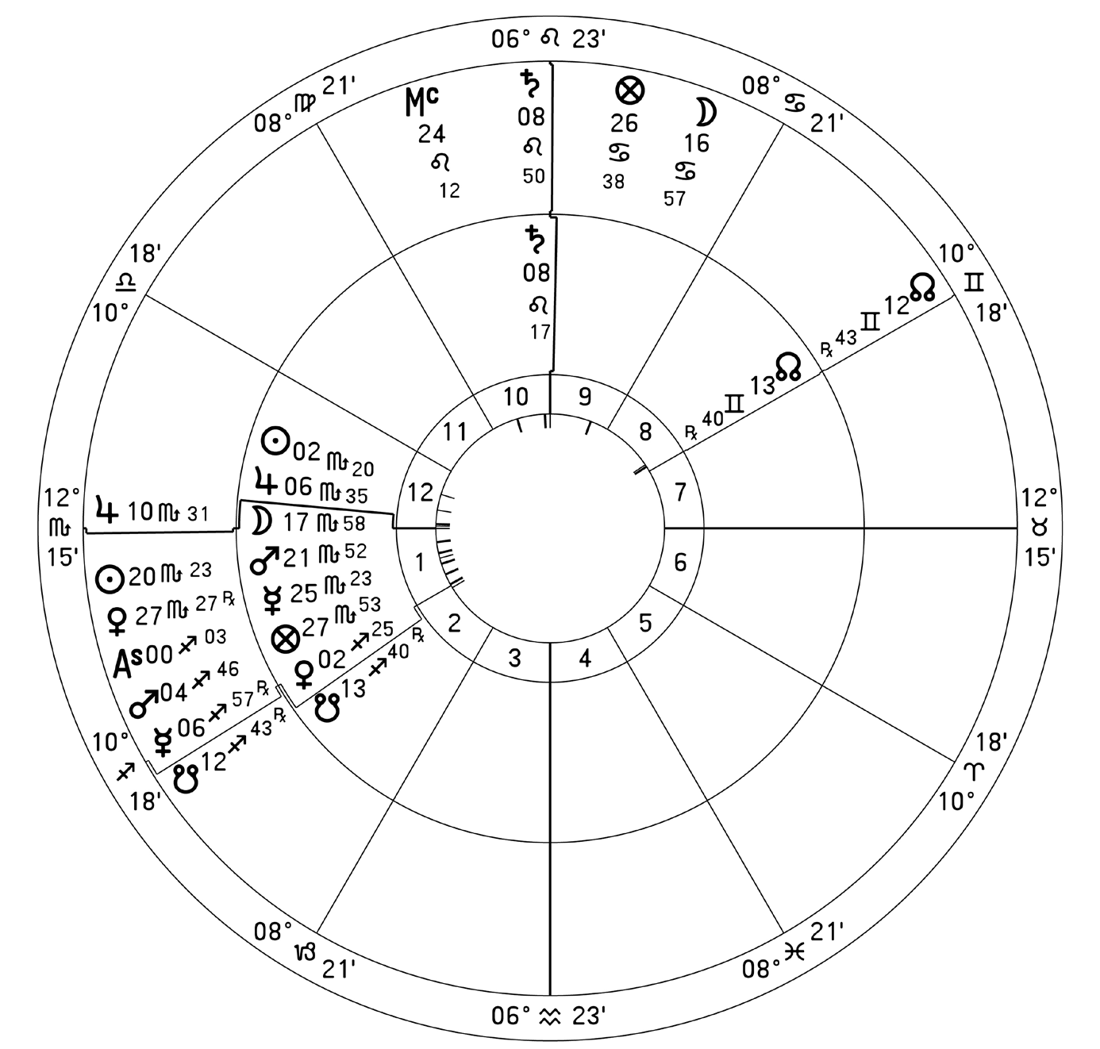
A imagem mostra, no círculo interior, o Mapa Natal, e no exterior as Progressões Secundárias para o dia 26 de Outubro de 1964. Faz-se visível que a esta altura do tempo, o Ascendente Natal, originalmente nos 12º54’ já teria percorrido todo o restante do signo do Escorpião. Nota-se que o Ascendente Progredido já tocou a sua Lua (aos 5 anos de idade), seu Marte (9 anos), seu Mercúrio (13 anos) e sua Fortuna Natal (15 anos), resultando na ideia de que, quaisquer que fossem os assuntos que tais astros representassem, já estariam todos eles ali despertos, acima da linha do horizonte, como que dados ao seu conhecimento e dispostos aos acordes dos seguintes acordos.
Como o Diabo gosta
Por acordos compreende-se o encontro de dois ou mais astros, cujas reverberações se fazem notáveis desde que testemunhadas por algum dos pontos hylegíacos: Sol, Lua, Ascendente e Meio-do-Céu. Se fazem notáveis porque esses pontos são associados às luzes, o fiat lux astrológico: o atrito dos astros, se testemunhados por uma partícula de luz, acende e consuma os assuntos por eles designados.
Dentre todos os atritos, alguns aqui listados, o mais relevante deles é o do Sol Progredido ao Marte Natal, em forte fricção na passagem de 1964 para 1965. O Sol, como regente do signo de Leão, localizado no Meio-do-Céu do mapa de Belchior, representa as suas aspirações, o seu nietzschiano meio-dia, o vir-a-ser que se cultiva sob a ideia de uma carreira ou coisa parecida da qual se possa orgulhar, como quem passa a ser o rei do próprio Destino. Esse Sol, a designar essas coisas todas, progride até o seu Marte Natal, que, por sua vez, representa o próprio sujeito em questão. É como se Belchior recebesse seu Destino em suas próprias mãos, e convém lembrar que seu Sol em Escorpião sempre assim o desejou.
Não quero regra nem nada
Tudo tá como o diabo gosta, tá
Já tenho este peso, que me fere as costas
E não vou, eu mesmo, atar minha mão5
Deste ano em diante, até que o Belchior suba pela primeira vez ao palco, o reconheceríamos ao modo maléfico, cavando a sua fama de Marte, com inclinações para a seita noturna e sua boemia, mais combativo do que quando frade, embora não tenha dispensado a disciplina. Sempre munido de seu violão, sua breve passagem pela Faculdade de Medicina de Porangabuçu parece ter tido mais valor pela possibilidade dos encontros da vida universitária, que agitadamente se organizava contra o avanço da política da extrema direita. De olho no nascente, sempre à esquerda de qualquer mapa, o Sol Progredido iria ainda tocar seu Mercúrio Natal, ali pelos 23 anos, de onde, certamente, se revelariam muitas ideias de letras e músicas. Conta o biógrafo que, de 1968 a 1970, apesar de não faturar lugar no pódio dos festivais para os quais enviava suas canções (defendidas por outros intérpretes), o momento era mesmo prolífico: “Em uma das mesas do Anísio, Belchior escreveria em um guardanapo de papel um clássico da MPB, Mucuripe, observando as jangadas que saíam para o mar de manhã e voltavam no fim da tarde (...) Fagner a levou para casa, e no dia seguinte, trouxe pronta a versão que ficou célebre”. Aos 25 anos, era 1971, o Sol Progredido alcançaria a sua Parte da Fortuna.
O horóscopo do almoço e a fome do cantador
Marte Progredido, por trígono, havia se alinhado ao seu Meio-do-Céu Natal, e olhando para lá, avistava Saturno, regente de sua Casa 4, seu endereço, sua família. A Lua progredida em Libra, testemunhou, por sextil, essa aliança, privilegiando a ideia do exílio de seu Saturno em Leão, com seu Marte, agora, peregrino. O Rio de Janeiro seria o seu primeiro destino e cenário do Festival Universitário da Tupi, no qual, nesse mesmo ano de 1971, pela primeira vez, Belchior subiria ao palco e defenderia, com violão e voz, a sua canção Na Hora do Almoço:
No centro da sala, diante da mesa
No fundo do prato, comida e tristeza
A gente se olha, se toca e se cala
E se desentende no instante em que falaMedo, medo, medo, medo, medo, medo
Cada um guarda mais o seu segredo
A sua mão fechada, a sua boca aberta
O seu peito deserto, sua mão parada
Lacrada e selada
E molhada de medoPai na cabeceira: É hora do almoço
Minha mãe me chama: É hora do almoço
Minha irmã mais nova, negra cabeleira
Minha avó me reclama: É hora do almoço!Ei, moço!
E eu inda sou bem moço pra tanta tristeza
Deixemos de coisas, cuidemos da vida
Senão chega a morte ou coisa parecida
E nos arrasta moço sem ter visto a vidaOu coisa parecida, ou coisa parecida
Ou coisa parecida, aparecida
Ou coisa parecida, ou coisa parecida
Ou coisa parecida, aparecida
O Meio-do-Céu é análogo ao lugar em que Sol alcança o clarão de seu meio-dia, das horas sem sombras. E por que o Leão aí figura no Mapa Natal de Belchior, é que tomamos o Sol, regente desse signo, como enunciador da sua carreira e das certezas que geralmente, em vida, são temidas, ainda que insistentemente perseguidas, com um herói que se faz com e contra o oráculo que prediz a sua divina tragédia. Justamente quando o Sol, contrarregra de sua carreira, alcança a sua a Parte da Fortuna, sobe ao palco. E como se não bastasse, o faz em defesa de uma canção que leva no título a hora do Meio-do-Céu, do meio-dia em que a família se reúne para o seu almoço. Essa coincidência faz ainda lembrar o seu Saturno, representante de seu Fundo-do-Céu, família e origem, projetado ao alto de seu mapa, que modulado pelo melancólico temperamento desse astro, cantará pai, mãe, irmã e avó reunidos nesse cotidiano rito de adiar a morte matando a fome de mais um dia.
Tanto a tonalidade que Saturno imprime em seu Meio-do-Céu como a evocação à sua terra natal e raízes seriam revisitadas em suas futuras canções, entre elas, Como Nossos Pais. Nesse mesmo ano, na ocasião de um dos vários saraus cariocas, Belchior faria contato com o “pessoal” da Elis Regina, que eternizaria a sua canção cinco anos depois. Como Nossos Pais integra as faixas do seu disco Alucinação, de 1976, e nesse mesmo ano é gravada por Elis Regina, em seu disco Falso Brilhante, nome que mais se parece a um epíteto de um Saturno exilado em Leão. O pano de fundo dessa e de outras canções é a do campo das artes cercadas pela ditadura, e embora seja um cenário violentamente repressor e consequentemente depressivo, a quieta inquietude do Sol em Escorpião defenderá em sua lírica um vigoroso devir de Marte, que sente tudo “na ferida viva do [seu] coração”. No seu relógio celeste particular, o Sol Progredido encontrou por conjunção a Parte da Fortuna, um marco vitorioso de um dos mais importantes momentos de seu Destino por aqui, não só no que diz respeito à sua canção do meio-dia dos cidadãos brasileiros, mas de prolíficos encontros e baladas que brindariam outros tempos.
Sua Parte da Fortuna, disposta por Marte, levaria Belchior a batalhar nos anos seguintes com e contra o Destino a sua própria sorte, fazendo da matéria da vida, que é misteriosa e sangra, “a única forma que pode ter norma”. Seu primeiro disco é lançado em 1974 e nas Progressões, a Lua já completava o seu primeiro retorno, isto é, tocava de novo o Ascendente, dando ao disco o nome do sujeito ali representado: Belchior. Não poderia ser diferente. Nesse disco escutamos alguns de seus clássicos, como A Palo Seco, dos “25 anos de sonho, de sangue e de América do Sul”, que coincide com a gloriosa idade na qual se deu o encontro do Sol Progredido à Parte da Fortuna, regida por Marte, que afia o canto feito faca. Também aí reconhecemos a canção que o leva ao palco, três anos antes, Na Hora do Almoço. Enquanto a Lua Progredida brotava de novo, no mesmo signo, refazendo os seus caminhos natais, fazendo conjunção, portanto, à sua Sigízia de Lua Nova, ao seu Sol e à própria Lua e Parte da Fortuna. Mote e Glosa, faixa que abre o disco, começa repetindo insistentemente “é o novo, é o novo, é o novo” e desafia, ao modo de um Marte repentista que ama cutucar rimando:
você que é muito vivo
me diga qual é o novo6
E como quem canta a própria vida, em Todo Sujo de Batom, ouvimos:
Quero uma balada nova
Falando de brotos, de coisas assim
De money, de banho de lua, de ti e de mim
Um cara tão sentimental7
Como se, de novo, a vida brotasse ali do Ascendente, a sempre sentimental Lua, na Progressão, alcança o seu marco zero, e novamente nova quase nos revela os enigmas de um Escorpião sempre cheio de segredos. Belchior, letrado, filósofo, frade ou médico talvez concordasse que dentre todos os mistérios de deus, o mais elevado fosse mesmo o tempo. Em seu relógio celeste, as mencionadas progressões do Sol e da Lua demonstram como o tempo engendra a si mesmo, fazendo daí por diante o Belchior que conhecemos, cantador e violeiro das coisas reais.
João, o tempo andou mexendo com a gente, sim
John, eu não esqueço
Oh no! Oh no!
A felicidade é uma arma quente8
Notas
- Belchior, Comentários a Respeito de John, Era Uma Vez um Homem e Seu Tempo, 1979. ↩
- Referência ao texto “Belchior, um violeiro de Marte” do astrólogo João Acuio, publicado em 2017 no site da Saturnália. ↩
- Belchior, Meu Cordial Brasileiro, Era uma Vez um Homem e Seu Tempo, 1979. ↩
- Belchior, Senhor Dono da Casa, Belchior, 1971. ↩
- Belchior, Como o Diabo Gosta, Alucinação, 1976. ↩
- Belchior, Mote e Glosa, Belchior, 1974. ↩
- Belchior, Todo Sujo de Batom, Belchior, 1974. ↩
- Belchior, Comentários a Respeito de John, Era Uma Vez um Homem e Seu Tempo, 1979. ↩
Belchior, a subject of the fortune of Mars
At the presence of the first rays of sunshine on October 26, 1946, the strong, safe and sound sign of Scorpio rose at the horizon at the small village of Sobral, in the state of Ceará, announcing the horoscope of a subject named Antônio Carlos Gomes Belchior Fontenelle Fernandes. The guitar player who knew Latin would flip through the Greek etymologies to see that Latinized horoscope means simply “to check the time”. In Astrology, horoscope is a synonym to the Ascendant, a fixed point to the East horizon where the Sun rises, for whom the rooster crows. Moreover, horoscope can also designate the whole Chart, due to this geographic spot’s symbolic importance, such as the reckoning of a life that starts the time it is sighted.
Rising at six in the morning, Antônio Carlos was born together with the sign of Scorpio. It peered with five of the seven stars: being daytime, of course, the Sun, which was at the 2nd degree; and next, as faithful followers of this enigmatic king, rose Jupiter at the 6th degree; the Moon at the 12th; Mars at the 21st and Mercury at the 25th degree.
The Ascendant is the spot that designates the subject itself - subdued to its physical body, where life deeply throbs. It is where the Latin American heart late – from the Spanish “beats” – also takes a beating. Again, on the beat, the Ascendant is the motivus – where life overcomes inertia to start its movement. It is the beginning. That is why Scorpio is a sign of the fortune of Mars, being its day domicile. The motivations of this singer and guitar player showed up directly and precociously. Mars is where almost all other stars are – at the start of the Chart. It has an extremely hot and dry quality, prone to action, clash and boldness. However, Scorpio is of cold and humid quality – opposite to Mars – it attenuates the proneness to direct conflict, granting it a threatening tone; hear it in the song Comentário a Respeito de John, proclamation of the sharp sign of its birth.
Get out of my way
I’d rather walk by myself
Let me decide
My own lifeI don’t need to be told
Where the Sun rises
Cause my heart beats there1
With so many stars placed where life begins, one can draw that most of what features in the mythical Belchior mentioned today was set up in the first years of his life. From this finding on, we shall bow to his Secondary Progressions – a predictive technique that supposes a symbolic temporal relation where each day after birth counts as one year of life. Assuming the relation between the Ascendant and beginnings, the interest on the following analysis takes two moments – the first is biographical, and relates to his first years; and the second relates to the first song sung on stage - Na Hora do Almoço (1971).
Small time chart
If we talk about Mars, fear and courage alternate as non-identical twin narrators of the hero’s legends. The stories and anecdotes that illustrate his Natal Chart compose his biography Belchior: Apenas um rapaz latino-americano (2017), written by Jotabê Medeiros in a witty tone, as if he were stung by Belchior’s sharp and daring humour – which the author is wisely suspicious of. Amongst the bravery stories of “Mars guitar player”2- prone to pride, value and stray – are those that tell of his singing at fairs and his mother’s at the choir’s mess, when he was young. If the Ascendant is indeed the subject in question, and together there are the Sun, Jupiter, the Moon, Mars, Mercury and the Part of Fortune, it is natural for him to demand – as in the song – to decide over his own life, and to retell his story in many versions. Astrologically, it is as though all matters related to those stars were in his hands - the Scorpion claws holding to Destiny´s rudder – whose captain is not-so-fearless Mars.
The Moon – which also represents subjective themes in this theatrical story, such as memory and feelings – is also under its designs. Whenever in Scorpio, the Moon is in fall, detriment or depression. The Moon also represents the mother. From the point of view of her son’s chart in a sign of Mars, Mrs. Dolores (Dolores!3) bore stories of battles and losses of new-borns or young children. She also carried the struggle to support those who followed on, as if the Moon itself embroidered her code of honour in a Mars’ campaign flag – life avenged retaliates.
The native sin
Is simply to be alive
Is to want to breathe4
While it is not difficult to make out that music and repente5 are common sites to this character, and Belchior complains and recalls how he wishes to be remembered - Scorpio elaborates its enigmas. His grandfather played the flute and saxophone and his uncles where seresteiros6. His origin rooted in his musical career, in blood and hereditary sense. The 4th House - also called Imum Coeli - designates land – especially homeland – and family, rooted there. In his Chart, the Imum Coeli is in Aquarius, with Saturn as its ruler, representing such matters. Saturn displaced in Leo at the Midheaven – that is, towards the stage of life – is as one offering roots as stock of musical notions with which Belchior sings life. Saying Saturn offers is as saying Saturn compels, because this cold and dry star’s nature is to have harsh respect towards the weight of such commitments.
Saturn’s prominence also raises other matters to his Midheaven. The 3rd House under the saturnian sign of Capricorn appoints Belchior’s first scholarly education. He studied at Colégio Sobralense, where he learned languages, and studied philosophy and music, including Gregorian chants, until he was 13 years old. In the 4th grade he stood out as class orator, due to special awareness and a sense of humour that was better than his report card. After his family moved to Fortaleza in 1960,
Belchior enrolled in the Colégio Estadual Liceu do Ceará, where his grades were always above average. There he composed a group of friends who would accompany him for the rest of his life. The other kids of his team were older – already fifteen – but fascinated by that mannerist chit who knew the Bible and French romances better than anyone. Amongst them were Cláudio Pereira (future journalist), Barbosa Coutinho (future psychoanalyst), and Fausto Nilo (future architect), a kid from Quixeramobim inseparable from Belchior, who became his partner in one of his greatest songs: Nada Como Viver, from the album Objeto Direto, 1980. (MEDEIROS, 2007)
As young as 13, still a boy and as clever as Mercury, Belchior caused awe because of outcomes from his head. Those are exactly the qualities assigned to Mercury – subtlety and intellection, insight and reasoning, thought and cunning. Mercury’s status in his Natal Chart is trebly happy – first, due to its condition of joy. For medical studies purposes, Astrology attributed to each House a part of the body – the Ascendant is the head. There, Mercury – the mind – rejoices and gets excited. Added to its sharp intellectual happiness is the applicative conjunction to the Part of Fortune – a spot in the chart that resonates lunar fertility, as an abundant and prolific source of life, as if his Mercury never lacked some sips of fiery inspiration. Fiery it is - because, lastly, Mercury is at the sign of Scorpio, modulated by Mars’s vigour and his disposition to serve it, because of their conjunction.
God is Brazilian and walks by my side
At this time and age in question, his progressed Ascendant gave in precisely to his Natal Mercury, and two years after that, it directed to his Part of Fortune. The relation between what happened in his first years at the Liceu and the Part of Fortune - this mysterious lunar potion - is noticeable. His 9th House was under the sign of Cancer - at mercy of the Moon’s calls. The Ninth’s other name is Place of God - a monastic scenery dedicated to higher studies, since in the old ages, religion, philosophy and knowledge were wisely placed together. At the end of 1963, the progressed Moon had entered this House and sign, as one who looks for habits and habitats that can comfort one’s soul, and trusts the call of the bells resounding in one’s symbolic celestial clock. Besides, the progressed Sun had touched the Moon two years before, reviving the desire to enter the gates of higher studies, when Belchior was not old enough for it. The solution was to study at the Order of Capuchin Friars at Guaramiranga from the beginning of high school. After announcing his wishes to his father – who encouraged him - Belchior did so: Friar Francisco Antônio de Sobral. The year of his entry was 1964. Withdrawn and oblivious to worldly news, Belchior only knew of the impeachment of João Goulart and the military coup three months after it happened.
Who are those men
Who are fighting
Night and day
Our Father, Holy Mary!7
He was also admired among his brothers at the order for his ever-lively humour and sudden creativity. Stories tell that besides his discipline and martial attention as an expert reader, he would also follow obligations, fasting and prohibitions strictly. Despite that, he would not give in to parodying religious stories and making rhymes in repentes in his free time walking tours. The religiously intellectual days celebrated by monastic life seemed to go well, despite the knowledge of things beyond the limits of the Place of God, to where the Moon was saying goodbye. While the Moon was shifting signs in the sky, situations were inviting to change on the ground. It was then the Devil knocked at his door:
However, in 1965, at the height of his crusade for the suppression of civil, political and thinking rights, the former President Marshal Humberto de Alencar Castelo Branco, born in Fortaleza, visited the Messejana Monastery. The novices from Guaramiranga were called to strengthen the welcoming efforts of the hosts towards the dictator, and Belchior did not escape the call. (MEDEIROS, 2007)
Also in 1965, the Sun progressed towards his Natal Mars, and Belchior knew he had to move on, as one who turns around the corner of a one-way street.
In the image the inner circle depicts the Natal Chart, and the outer circle the Secondary Progressions for October 26, 1964. At that point, evidently the Natal Ascendant - originally at 12º54’- had covered the rest of the sign of Scorpio. Noticeable is the Progressed Ascendant touching his Moon when he was 5 years old, his Mars at 9, his Mercury at 13, and his Natal Fortune at 15. As a result, whatever matters those stars represent were all awoke then, above the horizon line, as if they were available to his knowledge and disposed to the chords of the following arrangements.
Like the Devil
The understanding of agreement is the encounter of two or more stars, and such reverberations are remarkable if testified by one of the hylegian points: Sun, Moon, Ascendant or Midheaven. They are noticeable because these places are associated to light, the astrological Fiat Lux8: when testified by a particle of light, the friction of the stars lights up and consummates the matters designed to them.
Amongst these frictions, of some listed here, the most relevant is the Sun progressed towards Natal Mars, a strong chafing point between 1964 and 1965. The Sun as ruler of the sign of Leo is located at Midheaven on Belchior’s Chart, and represents his aspirations - his nietzschian midday - the yet-to-become cultivated under the idea of a career or something one can be proud of, as one who becomes the king of his own Destiny. A representation of all those things, the Sun progressed towards his Natal Mars, which, in turn, represents the subject itself. It was as if Belchior received his Destiny into his own hands – and remember, his Sun in Scorpio always longed for this.
I want no rules, nothing
Everything is like the Devil, ok
I already have this weight on my shoulders
So I won’t tie my hands myself9
From that year on, until Belchior first got on stage, his malefic ways were visible, and the making of Mars fame - of those inclined to the night sect and nightlife - more combative than when he was a friar, even though he had not given up on discipline. Always carrying his guitar, his brief passage through the Medicine College of Porangabuçu seems to have been of more value to meet people of hectic university life, due to the advance of extreme right politics. Eyes on the rising point, always to the left of any Chart, the progressed Sun also touched his Natal Mercury around 23 years of age, when many ideas certainly came up as lyrics and songs. According to his biographer, from 1968 to 1970 was indeed a prolific time - even though he did not reach the podium of the festivals where he sent his songs, sung by other singers. “Belchior wrote a MPB classic - Mucuripe - on a paper napkin on a table at Anísio’s, while he observed the jangadas10 leaving to sea in the morning and returning in the evening (...) Fagner took it home - the next day, he brought the version that became famous”. He was 25: it was 1971, and his progressed Sun had reached his Part of Fortune.
Lunch Horoscope and the singer’s hunger
Progressed Mars aligned in a trine to Natal Midheaven, and from there, it could see Saturn, ruler of the Fourth House - his address, his family. The progressed Moon in Libra testified to this alliance by a sextile, privileging the idea of exile of his Saturn in Leo with his Mars, now peregrine. Rio de Janeiro was his first destiny, the scenery of Festival Universitário da Tupi, where Belchior hit the stage for the first time, in this same 1971, to represent his song Na Hora do Almoço11, voice and guitar in hand:
In the centre of the room, in front of the table
At the bottom of the plate, food and sadness
We look at each other, we touch and we silence
And disagree the moment we speakFear, fear, fear, fear, fear, fear
Each one keeps their own secret more
Hands closed, mouth opened
Desert chest, hand still
Locked and sealed
Wet with fearDad is head of the table: It is lunchtime
My mother calls me: It is lunchtime
My youngest sister, a black mane
My gradma complains: It is lunchtime!Hey, lad!
I am too young for so much sadness
Let’s leave things behind, and care for life
Otherwise death or something like it will come
And take us young, without having seen lifeOr something like it, something like it
Or something like it, aparecida
Or something like it, something like it
Or something like it, aparecida
Midheaven is similar to the place where the Sun reaches the light of midday - the time of no shade. Since Leo is there in Belchior’s Natal Chart, as ruler of this sign, the Sun announces his career and certainties that are generally feared in life, and yet insistently sought after - like a hero who builds himself with and against the oracle that predicts his divine tragedy. He rose to the stage exactly when the Sun - a stagehand of his career – reached his Part of Fortune. As if that was not enough, at the stage, he rehearsed a song named after Midheaven – the midday time when family reunites to have lunch. This coincidence reminds us of his Saturn - a representation of his Imum Coeli, family and origin - projected towards the top of his Chart, modulated by this star’s melancholic temper. He sang of his father, mother, sister and grandmother gathered at this everyday rite, which postpones death by satisfying hunger once more.
Revisited in his future songs are both the tone Saturn imposed on his Midheaven and the call-up to his natal homeland and roots – among them, Como Nossos Pais12. That same year, in one of the several carioca soirees, Belchior contacted Elis Regina’s “personnel” – she eternalized his song five years later. Como Nossos Pais is part of his 1976 album Alucinação. The same year, Elis Regina recorded it in her album Falso Brilhante13 – a name that seems an epithet to an Saturn exiled in Leo. The backstage of this and other songs was the art scene surrounded by dictatorship; even though it was a violently repressive and consequently depressive scenery, the quiet unrest of the Sun in Scorpio defended a vigorous becoming of Mars in his lyrics, all feelings “in the open wound at his heart”. In his private sky clock, the Sun met the Part of Fortune in a conjunction – a victorious landmark of one of the most important moments of his Destiny – not only regarding his midday song of Brazilian citizens, but also prolific encounters and ballads that celebrated other times.
The Part of Fortune disposed by Mars made Belchior work for and against Destiny and his own luck the next years – he made life’s mysterious and bloody matter “the only thing that may have a standard”. His first record was released in 1974. In Progressions, the Moon had already completed its first return – that is, it touched the Ascendant again, and the record’s name represented the subject: Belchior. It could not be otherwise. In this record are some of his classics, such as A Palo Seco, with its “25 years of dreams, blood and of South America”. It coincides with the glorious time when the Progressed Sun met the Part of Fortune, ruled by Mars – sharpening singing like a knife. The song that took him to the stage three years before - Na Hora do Almoço – is also there. Meanwhile, the Progressed Moon burgeoned again in the same sign, retracing natal tracks - therefore, conjunct to his New Moon Syzygy, to his Sun and to the Moon itself, and Part of Fortune. The track that inaugurates the album is Mote e Glosa – it repeats insistently “it is novel, it is novel, it is novel” and, like a repentista Mars loving to tease, challenges with rhyme:
You, who are very lively
Tell me what is novel14
As one who sings his own life, in Todo Sujo de Batom he sings:
I want a new ballad
That sings of blooms, stuff like that
Of money, moon bathing, of you and me
Such a sentimental guy15
As life blooming again out of the Ascendant, the ever-sentimental Moon reached its ground zero in Progressions; while newly new, it almost displayed the enigmas of a Scorpio ever entwined in secrets. Belchior – a scholar, philosopher, friar or doctor might agree that amongst all God’s mysteries, the highest one might well be Time. In his sky clock, the Sun and Moon progressions demonstrate how time breeds itself, building the Belchior we know of - from then on, the singer and guitar player of real things.
João, time has been messing with us, yes
John, I cannot forget
Oh no! Oh no!
Happiness is a hot weapon16
Notes
- Belchior, Comentários a Respeito de John, Era Uma Vez um Homem e Seu Tempo, 1979. ↩
- Reference to the text Belchior, um violeiro de Marte written by astrologer João Acuio, published in 2017 at Saturnália’s site. ↩
- From the Spanish dolores = pains. ↩
- Belchior, Meu Cordial Brasileiro, Era uma Vez um Homem e Seu Tempo, 1979. ↩
- T.N. Repente is a Brazilian Northeastern style of rhyme where singers improvise debate in poetry. ↩
- T.N. Seresteiros are musicians who perform seresta, a genre of Brazilian street serenade music. ↩
- Belchior, Senhor Dono da Casa, Belchior, 1971. ↩
- T.N. As in Latin, “Let there be Light”, and aso, a famous Brazilian brand of matches. ↩
- Belchior, Como o Diabo Gosta, Alucinação, 1976. ↩
- Jangada is an open sailboat typical from the Brazilian northeast ↩
- T.N. Translates literally into Lunchtime ↩
- In Portuguese, “As our Parents” ↩
- In Portuguese, “False Diamond” ↩
- Belchior, Mote e Glosa, Belchior, 1974. ↩
- Belchior, Todo Sujo de Batom, Belchior, 1974. ↩
- Belchior, Comentários a Respeito de John, Era Uma Vez um Homem e Seu Tempo, 1979. ↩
Escola Saturnália · Biblioteca. Para citar: Mariana de Oliveira Campos, “Belchior, um sujeito da sorte de Marte”, /texto.php?id=126